Why Machine Code is Faster Than Bytecode: The Hidden Bottleneck in Your Code
If you have ever written a complex loop in Excel VBA and waited for your screen to stop freezing, you know that execution speed matters. But have you ever wondered what actually happens under the hood when your code runs? When comparing execution speeds across programming environments, one fundamental rule stands out: native machine code executes faster than bytecode. Understanding the difference between machine code vs bytecode helps explain why standard VBA scripts can lag and how compiling your code into native binaries gives your spreadsheets a massive performance boost.
What Is Machine Code? (The Native Speaker)
Machine code is the raw, zero-abstraction language of your computer’s processor (CPU). It consists of binary instructions—a stream of 1s and 0s—that directly control the CPU’s transistors.
When a CPU reads machine code, it doesn’t need to ask for directions. The instructions directly tell the hardware which registers to load, which arithmetic operations to perform, and where to store the result in memory.
Key characteristics of machine code:
-
Hardware Specific: Written specifically for a given processor architecture (like x86 or ARM).
-
Direct Execution: Runs straight on the hardware without software intermediaries.
-
Zero Overhead: No translation or runtime parsing needed at execution time.
What Is Bytecode? (The Intermediate Language)
Bytecode is an intermediate step between your human-readable source code and raw machine code. Languages like Java, C# (.NET), and even VBA (which compiles down to an intermediate format known as P-Code) rely on bytecode.
Bytecode isn’t designed for a physical CPU. Instead, it is written for a Virtual Machine (VM) or an interpreter—a software layer that sits between the bytecode and your actual hardware.
Think of bytecode like an international instruction manual written in Esperanto. Before your physical CPU (which only speaks binary) can follow those instructions, a translator must convert them line by line into native machine code.
Machine Code vs Bytecode Performance: 3 Reasons Machine Code Wins
Why exactly does machine code execute faster than bytecode? The performance gap comes down to three primary technical drivers:
1. Zero Runtime Translation Overhead
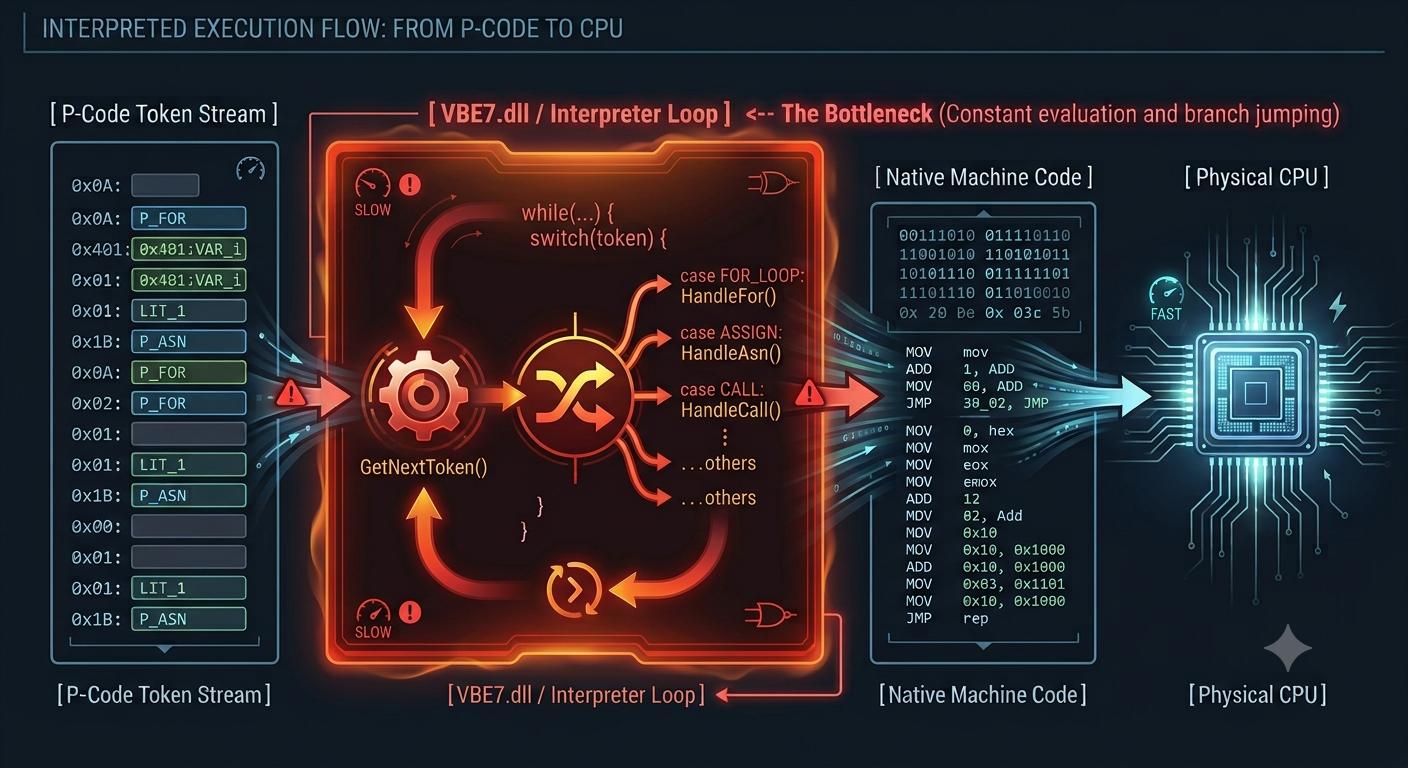
When running bytecode, the interpreter or Just-In-Time (JIT) compiler must fetch an instruction, figure out what physical CPU instructions match it, translate it, and then execute it. This extra layer of parsing eats up precious CPU cycles.
Machine code skips this middleman entirely. The CPU fetches the instruction and executes it instantly on the hardware.
2. Direct Hardware & Register Optimization
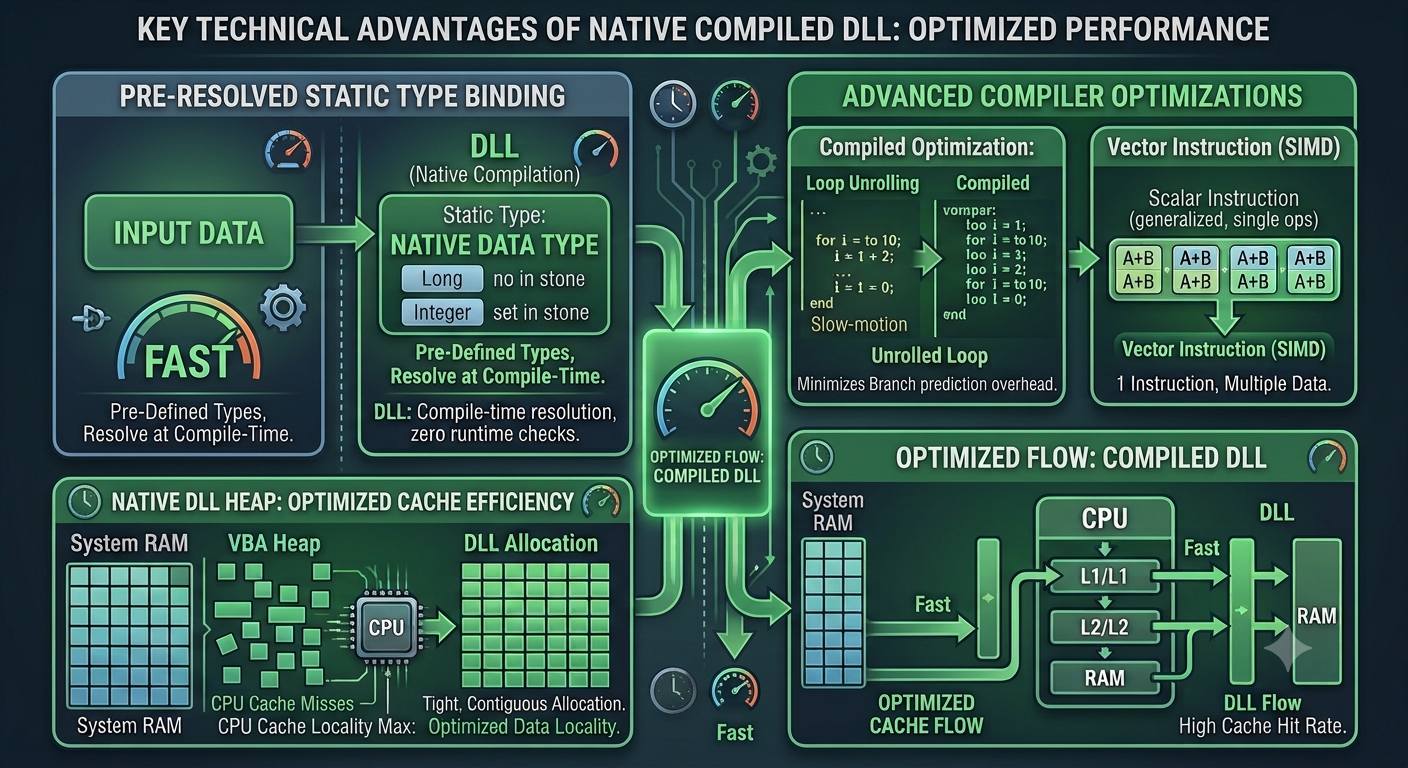
Native machine code compilers analyze your code before it runs to optimize how memory and CPU registers are used. They align data for your specific CPU architecture, leverage hardware-level vectorization, and take full advantage of instruction pipelining.
Bytecode must stay generic so it can run on any system, which prevents it from squeezing out maximum hardware-specific performance.
3. Lower Memory & Runtime Management Costs
Bytecode virtual machines must run background processes while your program is active. These include bounds checking, safety verifications, and memory management (like garbage collection).
In contrast, compiled machine code handles memory directly, eliminating background runtime overhead.
Real-World Analogy: Excel VBA vs. Native C/C++ DLLs
To see the machine code vs bytecode performance difference in action, look no further than Microsoft Excel:
-
Standard VBA: When you run a macro, Excel parses your code into intermediate P-Code (a type of bytecode). The VBA engine translates these P-Code instructions during execution, which slows down heavy mathematical loops, array manipulation, and complex algorithms.
-
Compiled C/C++ DLL: A compiled dynamic-link library (DLL) contains pure, native machine code. When Excel calls a native DLL, the processor executes the math directly on the chip at maximum hardware speeds.
The Verdict on Machine code vs Bytecode for Developers & Excel Power Users
Bytecode offers great cross-platform flexibility, but when pure speed, raw power, and algorithm protection matter most, machine code is the clear winner.
By compiling intermediate bytecode or VBA scripts directly into native machine code DLLs, you eliminate translation bottlenecks, protect your intellectual property from decompilation, and deliver near-instant results—even for the most data-heavy applications.


