Beyond Passwords: Moving VBA Protection to the Binary Layer
If you are distributing a high-value Excel workbook protected only by a standard VBA password, your code is essentially open-source—your Excel macros are not secure! Within seconds, an unauthorized user can strip Excel’s native locks and gain full access to your proprietary macros, and business logic. To truly protect your intellectual property, you need to treat your workbook like professional software. Compiling your spreadsheet using DoneEx VbaCompiler transforms fragile VBA code into a native Windows DLL, effectively building an impenetrable black box. Here is a look at the heavy-duty security mechanisms—from run-time integrity checks to selective API exposure—that turn an ordinary Excel file into a secure, commercial-grade application.
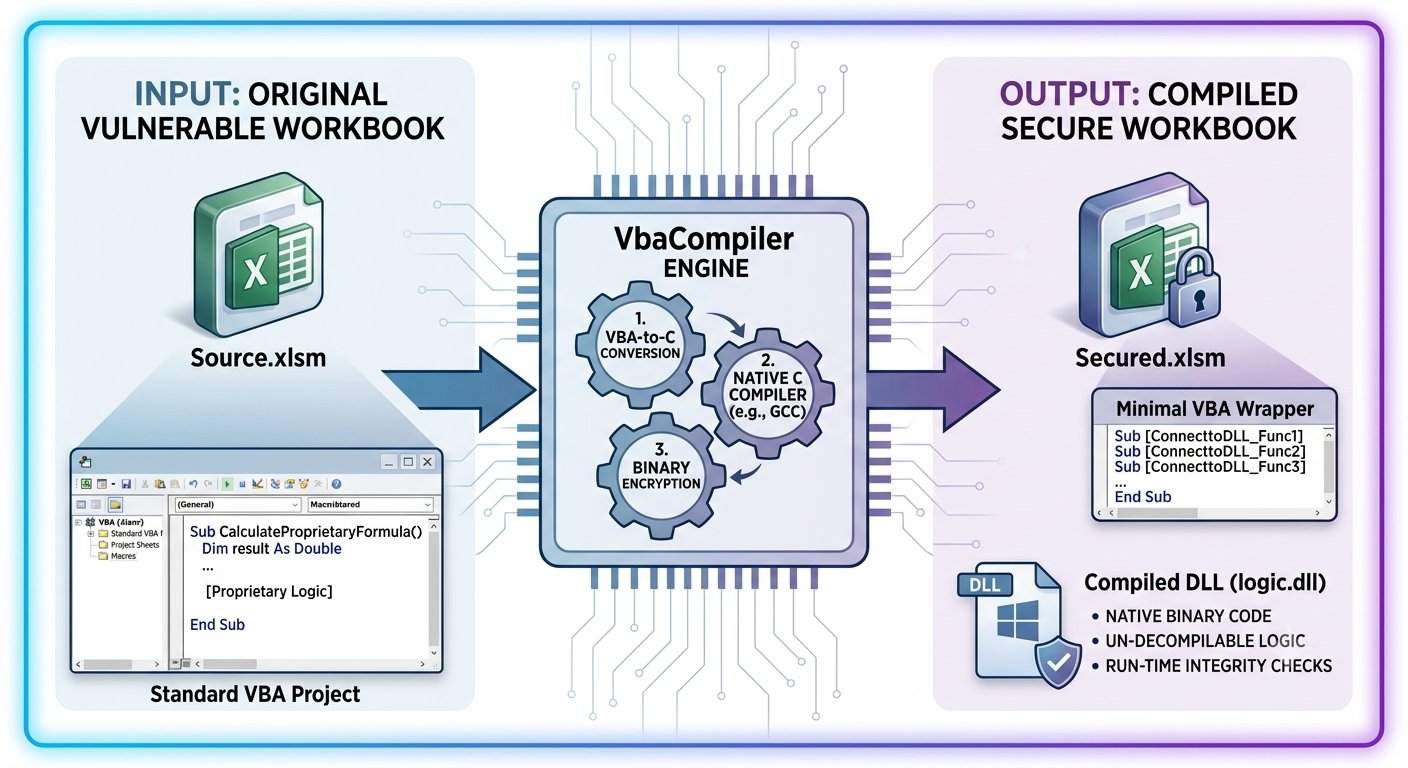
An analysis of the advanced security mechanisms applied to Excel workbooks compiled with DoneEx VbaCompiler for Excel:
Secure Excel Macros Through Code Inaccessibility & Decompilation Prevention
- VBA-to-C-to-Binary Transformation: Unlike standard tools that merely hide or obfuscate code, the compiler converts the source VBA code into C-language code, which is then compiled into a native Windows binary DLL file using an integrated C-compiler (like MinGW GCC or Microsoft Visual C).
- Complete Code Elimination: During the final phase of compilation, the original VBA code bodies are entirely removed from the workbook. They are replaced with a minor “connective VBA code” (or wrapper bridge) that merely calls functions from the compiled DLL. This is key to making the Excel macros secure, because if a hacker cracks open the Excel VBA Editor, there is no logic to steal.
- Impenetrable to VBA Decompilers: Because the logic is entirely housed in a compiled Windows DLL, it cannot be reversed back into readable VBA source code. This eliminates the threat of standard VBA password removal tools or MS Office VBA decompilers.
- Anti-Tracing Protection: The binary conversion ensures that malicious users cannot trace, pause, or observe execution flows or variable values via the Visual Basic Editor (VBE) debugging tools.
- Run-Time Binary Code Integrity Verification: To secure Excel macros against active hacking attempts and memory patching, the compiled workbook utilizes a sophisticated anti-tampering mechanism. During execution, the native binary code continuously monitors and verifies its own integrity. If a malicious actor attempts to modify the compiled DLL on disk, alter the binary structure, or inject code into the active memory space to bypass security restrictions, the runtime integrity check will instantly detect the anomaly. Upon detecting tampering, the application will automatically halt execution, neutralizing the threat before any proprietary logic can be compromised.
- Selective API Exposure & Attack Surface Reduction: To prevent malicious actors from mapping out the internal structure of the compiled application, the compiler utilizes a “Method Expose Mode“ driven by the [DNXVBC_VBA_EXPOSED_METHOD] compile-time attribute. By default, standard compilation might leave function names visible in the DLL’s Export Table or the connective VBA wrapper. By using this attribute, developers can precisely control the visibility of their compiled methods. Unmarked methods are entirely stripped from the public-facing DLL API and the connective VBA code, leaving only the essential entry points visible. This drastically minimizes the application’s attack surface and stops attackers from analyzing the workbook’s internal mechanics through API scanning.
- Static Analysis Defense: To prevent attackers from extracting sensitive text data via static binary analysis, the compiler encrypts all string literals and text values into a secure dictionary during compilation. These strings remain entirely encrypted on disk. The decryption key and dictionary are only loaded into memory after the application successfully launches and passes all registration, licensing, and credential verifications. This ensures that unauthorized users cannot scan the DLL for proprietary messages, SQL connection strings, or internal variables
Workbook Hardening & Project Integrity
- “Unviewable VBA” Option: The software can lock the VBA project structure completely, rendering the project “unviewable” within Excel. This prevents unauthorized users from altering or tampering with the newly generated connective VBA wrapper code.
- Original File Extension Maintenance: The final secured file retains its native extension (.xlsm, .xlsb, .xlam, etc.). This means it acts like a normal spreadsheet rather than an suspicious .exe file, lowering user friction while maintaining internal structural protection.
- Single-File Consolidation (Embedded DLL): For easier distribution and a cleaner security profile, the compiler allows the Windows DLL to be embedded natively into the compiled workbook itself. Upon launching the workbook, the file automatically extracts the DLL into memory or a temporary path, reducing the risk of a user intercepting or substituting the DLL file externally.
Copy Protection & Licensing Control
- Hardware Locking (Computer ID Binding): Users can enforce a strict copy protection mechanism. When a client opens the compiled workbook, it checks for a registration key. If missing, it generates a unique Computer ID based on the target machine’s hardware profile. The workbook will refuse to run unless the author provides a matching activation key tailored exclusively to that hardware profile.
- Physical Copy Control: While the file itself can still be copied physically from one computer to another, the functionality of the file is frozen. Copies placed on unauthorized computers will automatically block execution.
Time-Bombing, Trials, and Keeping Excel Macros Secure Through Distribution Management
- Time-Limited Registration Keys: The compiler includes a built-in “Registration Key Tool” allowing the author to set specific expiration windows (“date from” and “date to”) for compiled workbooks. Once the timeframe lapses, the DLL ceases execution.
- Trial/Demo Functionality: Authors can configure a limited trial period (e.g., access for a specific number of days) without requiring initial registration, automatically locking down the core calculations after the trial expires.
- Freemium Tiers: You can selectively compile specific advanced macros or procedures into the locked DLL while leaving basic macros open, establishing gated features for monetization.
Infrastructure & Environment Security
- Virtual Machine (VM) Blocking: To prevent attackers from reverse engineering licensing systems or cloning authorized environments, the software can actively block the compiled workbook or add-in from running inside virtualized environments (VMs).
- Digital Signatures Support: The compiler architecture allows authors to apply digital signatures directly to the compiled DLL file. This provides cryptographic proof of identity and code integrity, heavily mitigating anti-virus false positives and preventing malicious code-injection into your DLL.
- Customized Runtime Error Obfuscation: Standard VBA error messages often leak variable names, module titles, and structural logic. By shifting code execution to the DLL and utilizing customized runtime messages, any error reporting is securely controlled by the developer.
Distributing commercial or proprietary Excel workbooks with standard VBA passwords—or even text obfuscation—is no longer a viable security strategy. True intellectual property protection requires shifting from application-level hiding to operating-system-level hardening. By converting vulnerable VBA into a native Windows binary DLL, DoneEx VbaCompiler eliminates the source code from the workbook entirely. With built-in run-time integrity checks, copy protection, and precise API exposure control, compilation transforms a fragile spreadsheet into a self-defending, commercial-grade software application.


